Korea's Short-Haul Squeeze: Japan and China Tighten Their Grip on Outbound Travel
A four-day Chuseok was supposed to give Korea's outbound market a lift. Instead the holiday confirmed a structural shift: Koreans are flying more often, but to fewer, closer places. Japan and China are absorbing almost all of the growth, and Southeast Asia is paying for it.

SEOUL. South Korea's autumn harvest holiday has long been the second-biggest outbound window of the year after Lunar New Year. This September it delivered record crowds at Incheon, but little of the broad-based growth travel sellers had hoped for. Agency booking data and airport statistics published over the past fortnight point the same way. Korean outbound demand did not expand across the board during Chuseok; it concentrated. Roughly nine in ten holiday bookings at the big package houses went to Japan, China or Southeast Asia, and within that group the balance tipped decisively towards the two North Asian neighbours.
The Korea Travel Times, the country's main trade newspaper, summed it up in a 23 October market report headlined, in translation, "No growth even at Chuseok: outbound travel's lean towards Japan and China hardens". The data behind that headline matters well beyond Korea. With close to 30 million outbound trips a year, Korea is one of Asia's largest source markets, and where its travellers go next shapes airline schedules, hotel yields and tourism-board budgets from Hokkaido to Da Nang.
Ninety per cent short-haul
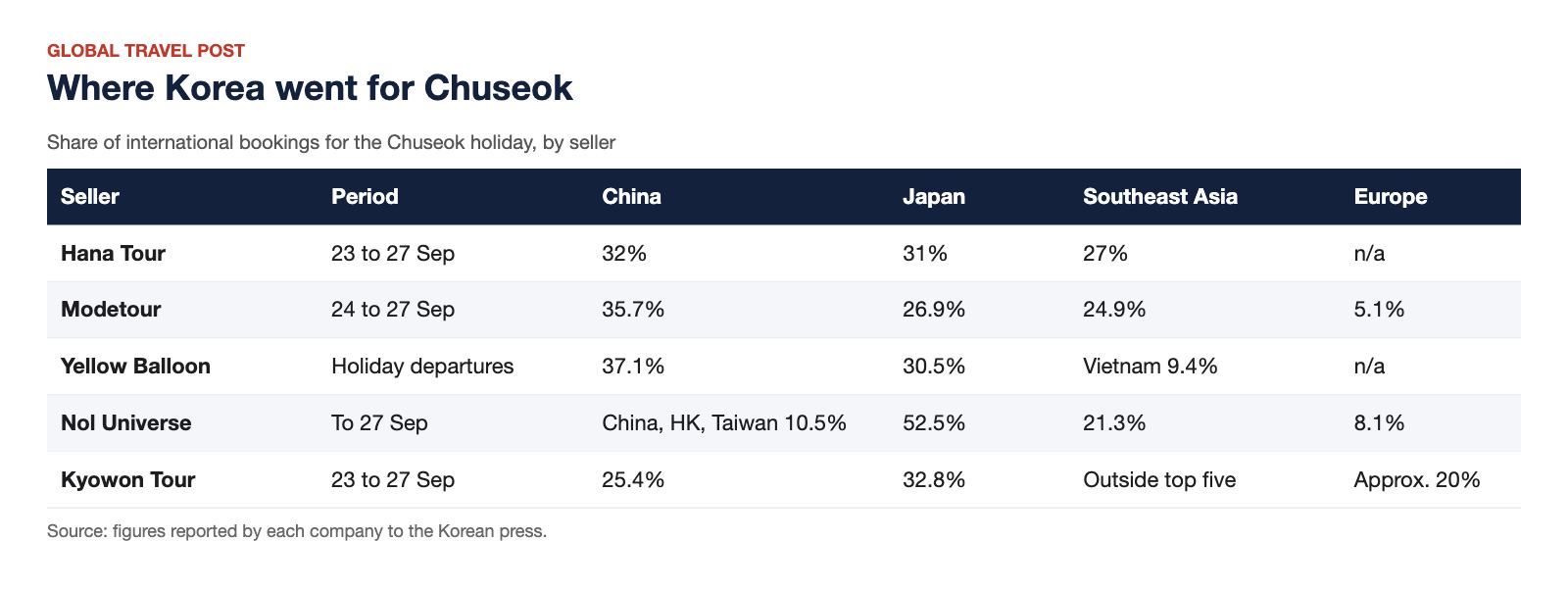
At Hana Tour, Korea's largest tour operator, China took 32 per cent of Chuseok departures between 23 and 27 September, Japan 31 per cent and Southeast Asia 27 per cent. Together the three short-haul regions accounted for 90 per cent of holiday bookings, up from 83 per cent a year earlier. Modetour, the number two, reported a near-identical picture: China 35.7 per cent, Japan 26.9 per cent, Southeast Asia 24.9 per cent, Europe 5.1 per cent and the Americas and South Pacific 4.7 per cent. At Yellow Balloon, China led with 37.1 per cent, followed by Japan at 30.5 per cent, Vietnam at 9.4 per cent and Taiwan at 7.4 per cent.
The online platforms, which skew towards independent travellers rather than package buyers, showed Japan even further ahead. Nol Universe, the parent of Interpark and Yanolja's travel businesses, said Japan took 52.5 per cent of its international bookings for the holiday period, up 10.3 percentage points from 42.2 per cent at Chuseok 2025. Southeast Asia followed at 21.3 per cent, China, Hong Kong and Taiwan combined at 10.5 per cent, Europe at 8.1 per cent and the Americas at 3.4 per cent. Klook recorded a 16 per cent year-on-year rise in Korean interest in Japan and a 39 per cent rise for China in the two weeks before the holiday.
What unites the datasets is not that Japan or China won; it is that everything else lost. Kyowon Tour noted that Vietnam and Thailand, perennial holiday favourites, both dropped out of its top five destinations for the holiday. Even within Japan the demand is dispersing, away from Tokyo and Osaka towards Hokkaido, Kyushu and secondary cities such as Takamatsu, Matsuyama, Wakayama and Tsushima. In China, nature-led itineraries to Zhangjiajie, the Taihang Mountains, Guilin and Changbai Mountain, known in Korea as Baekdu, dominated, with Kyowon reporting that scenic tours made up 72.9 per cent of its China sales.
What the airport saw
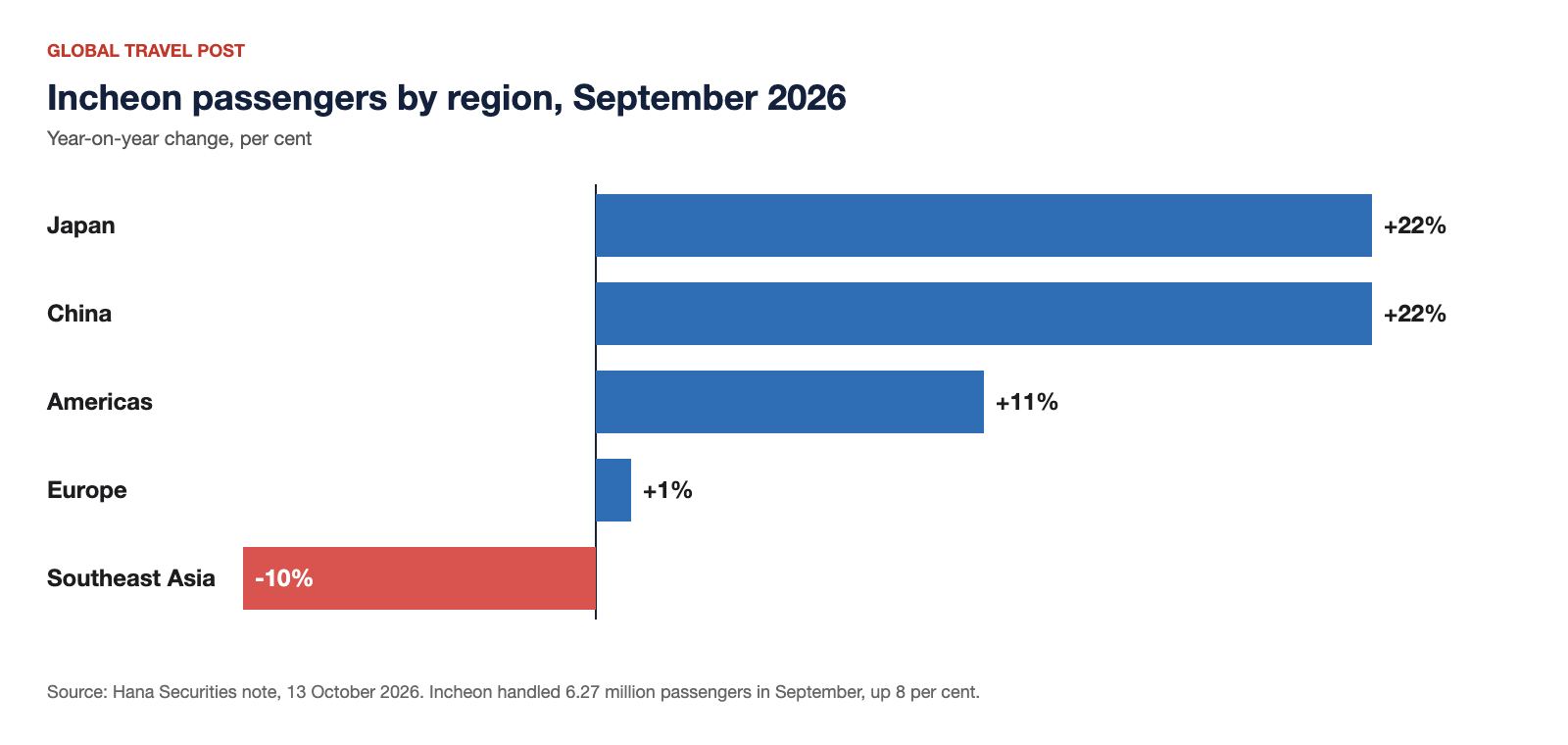
The booking shares are borne out by hard traffic data. Incheon International Airport handled 6.27 million passengers in September, up 8 per cent on a year earlier, according to a 13 October note from Hana Securities analyst Ahn Do-hyeon. Japan and China routes each grew 22 per cent. The Americas rose 11 per cent and Europe 1 per cent. Southeast Asia fell 10 per cent, the only major region to shrink in a month that contained the country's second-biggest holiday.
The quarterly figures from Incheon International Airport Corporation tell the same story over a longer run. Third-quarter international passengers reached 19.95 million, up 6.9 per cent. Japan traffic rose 20.4 per cent to 5.30 million and China traffic 24.9 per cent to 4.25 million, with passenger growth on both outpacing the growth in flights. For the first nine months of the year, Ministry of Land data put Japan-route passengers at 23.96 million, up 20.5 per cent, and China-route passengers at 15.42 million, up 22.9 per cent, against 9.9 per cent growth for all international routes combined. Two markets, in other words, delivered more than double the system-wide growth rate while the rest of the network grew far more slowly.
Japan's own arrivals data confirms how lopsided the relationship has become. The Japan National Tourism Organization counted 842,300 Korean visitors in September, up 25.6 per cent year on year and the largest single source market by a wide margin, at a time when total foreign arrivals to Japan fell 5 per cent on a collapse in Chinese demand. Korea sent 9.46 million visitors to Japan in 2025 and 5.68 million in the first half of 2026 alone, a pace that puts a 10 million year within reach.
Ahn cautioned that a single month's growth rate should be read carefully, since the timing of Chuseok shifted demand into September that fell in October in 2025. That base effect, however, cuts against the Korea Travel Times headline rather than for it: even with the holiday squarely inside the month, overall outbound growth was modest, and it came almost entirely from two destinations.

Four forces pushing in the same direction
The first is the calendar. Chuseok 2026 ran for four days, from 24 to 27 September. In 2025 it fell next to National Foundation Day and Hangul Day and stretched to as long as ten days for anyone willing to use a little leave. A long weekend is enough for Fukuoka or Qingdao; it is not enough for Phuket, let alone Paris.
The second is the price of flying. Korean carriers raised fuel surcharges on international tickets in September and again in October as crude prices climbed on tensions in the Middle East. Because surcharges are banded by distance, the increase hits a seven-hour flight to Bangkok far harder in won terms than a 90-minute hop to Osaka. Korean travel firms cited this explicitly when explaining the collapse in long-haul and Southeast Asian bookings.
The third is currency and visas. The yen remains weak against the won, keeping Japan cheap on the ground even as hotel rates in Tokyo and Kyoto climb. China's visa waiver for Korean passport holders, introduced in November 2024 and since extended through 2026, has removed the single biggest friction in that market. Sellers report that older Koreans, long the core of the China package business, are returning in numbers, and that the nature-and-scenery itineraries they favour are among the fastest-growing products in the catalogue.
The fourth is supply. Korean low-cost carriers, squeezed on margins by fare competition on trunk routes, have been opening secondary cities in Japan and China at a remarkable clip. Jeju Air resumes Incheon to Kagoshima on 25 October and Incheon to Hakodate on 1 December, and launched Busan to Guilin in September. Aero K now serves Hakodate, Matsuyama, Hanamaki, Fukushima and Toyama on a charter basis and opens Cheongju to Kumamoto in December. Jin Air has added Incheon to Yichang and Kobe. Eastar Jet has gone into Hohhot, Zhangjiajie and Xiamen. Each new regional route creates demand that did not exist before, much of it from repeat visitors who have already done Tokyo and Shanghai, and almost all of it pointed at Japan and China. Southeast Asia, by contrast, has seen no comparable wave of new routes, and its traffic fell.
The bill lands in Southeast Asia
For Vietnam, Thailand and the Philippines, the Korean market has been the dependable engine of the post-pandemic recovery. That engine is now sputtering. Vietnam welcomed 3.0 million Korean visitors in the first nine months of 2026, 17.3 per cent of all arrivals, but 5.5 per cent fewer than a year earlier, according to the National Authority of Tourism. It was the only major market among those reported to decline in a period when total arrivals grew 14.5 per cent to 17.7 million, and it happened while Russia, India and the Philippines were posting double- and triple-digit gains. Korea, Vietnam's largest source market as recently as 2024, now sits a clear second behind China, and the gap is widening.
Korean sellers are candid about why. A Vietnam or Thailand trip typically needs five days to make sense, which rules out most of this year's holidays. Rising hotel and restaurant prices in Vietnam and Thailand have narrowed the cost gap with Japan, eroding the value argument that once made Southeast Asia the default for Korean families. The long-standing complaint about heat and humidity has not gone away either; Seoul Economic Daily quoted agents describing Southeast Asia's cheap-and-cheerful reputation as a thing of the past.
None of this means Korean demand for Southeast Asia is gone. Vietnam still took 9.4 per cent of Yellow Balloon's holiday bookings, Hana Tour's Southeast Asia share held at 27 per cent, and Korean carriers continue to fly dense schedules to Da Nang and Bangkok. But the growth has gone elsewhere. Destination marketers in the region who built their 2026 plans on continued Korean expansion will need to revisit them.
What happens next
The industry expects the pattern to persist into the fourth quarter. October's Hangul Day holiday is another short break, and the major agencies are already bundling flights, hotels and hire cars into three- and four-day Japan and China packages priced for travellers who cannot take a full week off. Competition on those two markets will intensify, which is good news for Korean consumers and a headache for sellers' margins; several already warn that rising passenger numbers are not translating into rising profits.
The open question is whether this is a cyclical response to a short holiday calendar and high fuel costs, or a lasting change in how Koreans travel. The evidence leans towards the latter. Shorter, more frequent trips suit a workforce with little leave and an older population with time but a preference for comfort. Low-cost carriers have built their route networks around that behaviour. And the Japan habit, once formed, has proved remarkably sticky through currency swings and overtourism headlines alike.
For destinations outside North Asia, the lesson of Chuseok 2026 is that the Korean market can no longer be treated as a rising tide. It is a river, and it is cutting a deeper channel towards Japan and China every quarter.
Danh Dat Nguyen covers aviation and the business of travel for Global Travel Post.
Sources
Korea Travel Times, 23 October 2026: outbound travel's Japan and China concentration hardens despite Chuseok
Korea Daily / JoongAng, 28 September 2026: Hana Tour, Modetour and Yellow Balloon Chuseok booking shares
Sankyung Today, 24 September 2026: Nol Universe and Klook Chuseok data
Seoul Economic Daily, August 2026: Kyowon Tour bookings and JNTO figures
Pinpoint News, 13 October 2026: Hana Securities note on Incheon September traffic by region
Kyeongin Ilbo, 21 October 2026: Incheon International Airport Corporation Q3 figures
Global Economic, 22 October 2026: Aviation Information Portal nine-month route data and LCC regional expansion
Japan Korea Daily, 21 October 2026: JNTO September 2026 arrivals
VietnamPlus, October 2026: Vietnam international arrivals January to September 2026
Get The Post.
The global travel stories that matter, three mornings a week. Free.


